
Our industry has never mattered more, and it has never been more divided. Here’s why that has to change, and why you’re part of the answer.
“Why does the wellness industry need another association?” I get asked that a lot.
It’s a fair question. I’ve worked in wellness for 26 years, on all types and sizes of business across 15 countries. I’ve seen first-hand how much good this industry does. I’ve also seen how often we work alone, each modality in its own corner, faced with the same challenges and problems.
So here’s my answer. It comes in two parts: the problem we have today, and the much bigger one coming towards us.
Part one: we’re booming, but fragmented
Wellness is one of the fastest-growing industries in the world. The Global Wellness Institute values it at US$6.8 trillion. Here in Australia and New Zealand, it spans fitness studios and day spas, physiotherapists and naturopaths, counsellors and longevity clinics, bathhouses, retreats, real estate developers and the suppliers, educators and advisers behind them all.
But we don’t act like one industry. Spa talks to spa. Fitness talks to fitness. Clinical and holistic practitioners work in parallel worlds. Meanwhile, our clients move freely between all of us. The same person might see a physio on Monday, do reformer Pilates on Wednesday and book a massage on Saturday.
Working in silos costs us in real ways:
- No shared voice. When government, regulators or the media want to talk to “the wellness industry”, there’s no one to call. Decisions that affect us get made only in specific sectors, or – worse still – without us.
- No shared data. Ask how big the Australasian wellness industry is, or how each part of it is performing, and the honest answer is that nobody really knows. Without data, it’s hard to plan, invest or be taken seriously.
- No shared standards. When one part of the industry makes headlines for the wrong reasons, everyone’s credibility takes the hit. Clients can’t easily tell good practice from bad.
- No shared career path. Many practitioners work across several modalities, like the naturopath who also teaches yoga. Most associations only see one slice of who they are.
- Too many people working alone. Plenty of wellness businesses are small or solo operators, carrying every challenge on their own shoulders.
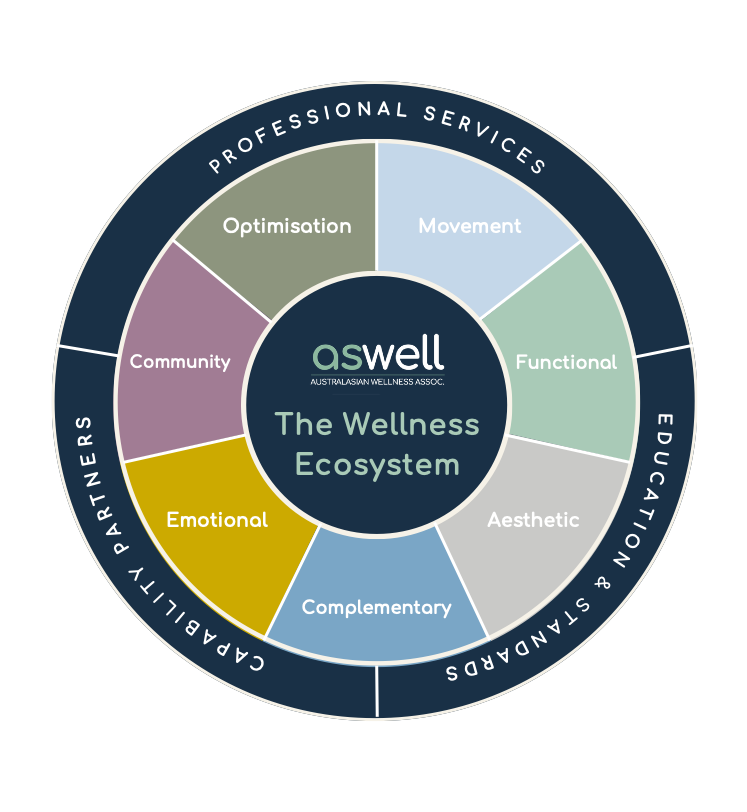
ASWELL was founded to fix this. Set to launch on 25 October, we aim to be the first peak body built for the whole wellness industry across Australasia, bringing all sectors of the wellness ecosystem under one roof.
That alone would be reason enough. But it’s not the main reason I believe ASWELL matters.
Part two: the world of work is about to change
Artificial intelligence and robotics are reshaping work faster than any technology before them. Nobody knows exactly how far or how fast this will go, and the forecasts vary enormously.
- The World Economic Forum expects 92 million jobs to be displaced worldwide by 2030, while 170 million new ones are created.
- Jobs and Skills Australia found generative AI is more likely to change jobs than replace them outright, with clerical and administrative roles most exposed.
- At the far end, some scenario planners, such as the AI Futures Project, describe futures where AI and robots will replace up to 90% of today’s work within a decade.
Wherever the truth lands, one thing is certain: millions of people will see their work change, shrink or disappear. Many will need to retrain, change careers or rethink what they do with their days.
Here’s what worries me. Work gives us far more than a pay cheque.
Back in the 1980s, social psychologist Marie Jahoda identified the hidden benefits of a job: a structure to our day, regular contact with other people, a sense of shared purpose, social status, and something meaningful to do. A 2023 analysis of more than 100 studies confirmed it: people out of work miss out on all of these, and losing them is linked to poorer mental health. An earlier landmark review found that 34% of unemployed people experienced psychological problems, compared with 16% of those in work.
So when work changes, people don’t just lose income. They can lose:
- Identity and purpose: when asked “Who are you?”, many people answer with their job title
- Daily routine: the rhythm that gets us up and out the door
- Status: the feeling of being valued and useful
- Belonging: the colleagues and community we interact with every day
And we’re not starting from a strong position. At least one in three Australians already report feeling lonely.
Wellness is where people rebuild
This is where our industry comes in. Look at what people stand to lose, and then look at what wellness does every day.
| What people need | Where wellness helps |
| Identity and purpose | Self-awareness, developed through coaching, counselling, mindset support, learning new skills and finding new meaning |
| Daily routine | Movement, classes, regular rituals and healthy habits that give a day its shape |
| Status and self-worth | Confidence, self-care and the feeling of being looked after and valued |
| Belonging | Clubs, studios, bathhouses, retreats and communities where people connect face to face |
| Mental and emotional health | Stress management, psychology, counselling, meditation, breathwork and the benefits that come from community and healthy lifestyle change |
| Physical health | Allied health, functional and complementary care, prevention and longevity |
No other industry touches all of these at once. That’s why I believe the wellness industry can be one of society’s most important safety nets as the world of work changes.
To be clear, we’re not a replacement for health services, mental health care or government support. We work alongside them. Wellness is the first, most accessible and most human place people can turn to, long before they’re in crisis.
A net, not a patchwork
Here’s the catch. A single business is a single thread. On its own, it can only hold so much.
A safety net works because the threads are tied together. When a gym knows a good counsellor, when a spa can refer to a trusted physio, when a retreat works with a nutritionist, people get caught, not lost in the gaps between us.
That’s what ASWELL is for: to help every part of the wellness industry link arms. In practice, that means:
- Connecting the threads. Bringing practitioners, businesses, suppliers and educators together across every modality, so referrals and partnerships happen naturally.
- Raising the standard. Developing shared standards and best practice, so the public can trust the net they’re falling into.
- Building the evidence. Through ASWELL Vitals, our regular member survey, and a program of industry-wide research, we’ll show governments and funders what our industry contributes, in numbers.
- One voice at the table. Making sure wellness has a seat alongside health, education and government when decisions about the future of work and wellbeing are made.
- Opening new doors. Wellness work is built on human connection. As jobs change, our industry could also become a welcoming new career path for people looking for meaningful, human-centred work.
Why you should be part of it
A net is only as strong as the people holding it. That’s where you come in.
Whether you’re a yoga teacher, a spa owner, a physio, a supplier, an educator or a student just starting out, you’re already part of the wellness ecosystem. ASWELL is your chance to be part of something bigger: to be seen, to be heard and to help shape where our industry goes next.
There’s a place for everyone:
- Student Membership ($99 a year) for those studying towards a career in wellness
- Professional Membership ($199 a year) for individual practitioners and professionals
- Corporate Membership ($450 a year) for businesses, covering up to three team members
- Industry Partners ($5,000 for an initial two-year term, then renewed annually), an ongoing partnership for one leading company per subcategory, including Corporate Membership and a seat on our Advisory Council [Industry Partner link]
Not ready to join yet? Start with our free Visibility & Growth Scorecard. It takes five minutes and shows you how visible and credible your wellness business is today.
We’re launching publicly at The Wellness Summit Asia Pacific in Western Australia (25–27 October). If you’re there, come and say hello.
Belong to something bigger
I started ASWELL because I believe our industry is stronger together than apart. The changes coming to the world of work make that more true, not less.
The people we serve will need us more than ever. Let’s make sure that when they reach out, there’s a strong, connected industry ready to catch them.
Belong to something bigger. Become something greater. Join today!
Samantha Dunn, Founding President, Australasian Wellness Association
Sources
- Global Wellness Institute, Global Wellness Economy Monitor 2025 (Nov 2025)
- World Economic Forum, Future of Jobs Report 2025 (Jan 2025), as reported by AI Magazine
- Jobs and Skills Australia, Generative AI to augment and advance the way we work in Australia
- AI Futures Project, AI 2040 (scenario, not a forecast)
- Batinic et al., Employment status, psychological needs, and mental health: meta-analytic findings concerning the latent deprivation model, Frontiers in Psychology (2023)
- Paul & Moser, Unemployment impairs mental health: Meta-analyses, Journal of Vocational Behavior (2009)
- The New Daily, Epidemic of loneliness plagues Australia (Nov 2024)